Contact Lenses
The concept of contact lenses goes back about 450 years, to the time of Leonardo da Vinci, but it wasn’t until 1947 that significant progress in lens design made contact lens practical for the average person. In 1971, Sir Robert Morrison, a Pennsylvania optometrist brought the soft contact lens to America and sold the rights to Bausch and Lomb for mass production. Many people wear contact lenses in place of glasses for cosmetic or aesthetic reasons. But there are also medical indications for the wearing of contact lenses. About 26 million people in America wear contact lenses, and that number is constantly increasing. This popularity is due to the many improvements made in the design and availability of contact lenses and the fact that they have been made more comfortable and easier to wear. Contact lenses are also suited for people with medical conditions where eyeglasses do not provide adequate clarity of vision. Ninety-five percent of those who want to wear contact lenses and who are well-motivated can do so successfully, under ideal circumstances. The key for successful wearing rests with the wearer. However, for others, some organic or systemic disease may bar the use of contact lenses.
Types of Contact Lenses
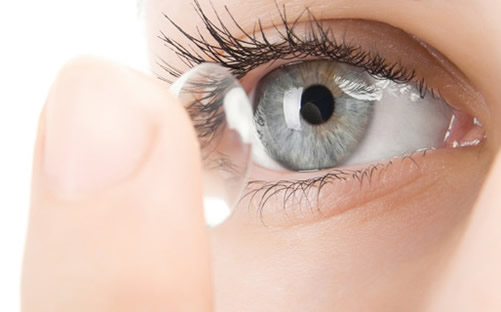
Contact lenses are tiny, curved plastic discs which are microthin, very light and barely visible. There are two major types: hard and soft. Hard Lenses


When Should Contacts Not Be Worn
Wearing contacts while sleeping can cause eye irritation, discomfort and, sometimes, corneal disorders. Only extended-wear lenses can be worn full time. As a rule, lenses should not be worn while swimming, or sitting in a hot tub. Under special circumstances and only with a eye doctor’s permission, some patients may be able to wear their lenses while swimming, if they wear good protective goggles.
Contact Lens Warning Signs
Because vision is sharper with contact lenses than with eyeglasses, you may notice that you do not see as clearly when you first put on your glasses after removing your lenses. This should only be a temporary sensation, and you should become oriented to your glasses in a minute or two. However, if there is blurriness or an actual change in the clarity of your vision, and if it is more than momentary, you should consult your physician immediately. A small percentage of soft contact lens wearers may be at risk of development of vision-threatening corneal ulcer or ocular infections. However, by adhering strictly to your eye doctor’s recommended lens care guidelines, chances are excellent that these complications can be prevented. Acute pain and redness are symptoms which require immediate removal of the lens and prompt attention by an ophthalmologist. Early detection of complications is essential to successful treatment. Call your doctor if:
Advice for Contact Lens Wearers
-Do wash, rinse and dry your hands before handling the lenses –Do carry identification stating that you wear contacts, so they can be removed in case of an accident -Do follow your doctor’s instructions about regular checkups -Do learn to insert and remove lenses correctly -Do keep a backup pair of glasses -Do be careful applying makeup; apply after insertion of the lenses -Do carry your contact lens case and glasses at all times -Do use only those solutions recommended by your doctor -Do use commercially prepared saline and other cleaning solutions -Don’t rub eyes while wearing lenses -Don’t wear damaged lenses -Don’t wear lenses while sleeping, or continuously, unless specifically prescribed by your doctor- Don’t use any eyedrops on your lenses without your doctor’s approval -Don’t insert, remove or work with lenses over a wash basin -Don’t place lenses on top of anything warm; they will melt -Don’t wear lenses while under a hair dryer or around harsh fumes -Don’t use saliva or tap water on your lenses as a wetting agent -Don’t use homemade saline solution or distilled water in preparing your lens care products -Don’t reinsert your lenses without disinfecting them
Frequently Asked Questions
Should I wear contact lenses? Many people who wear contacts instead of glasses are happier because they feel they look better. The most important key to successful contact lens wearing is strong personal motivation! Are you willing to put up with certain discomforts? To learn the proper techniques of cleaning and taking care of the lenses? To keep to your wearing schedule? To have regular checkups? If you can answer YES to the above, you probably have the attitude and motivation to wear contact lenses successfully. Which contact lens is best for me? Hard, Gas-Permeable Lenses Advantages: